

Did VAR apply an outdated rule? Mbappé’s penalty should have been retaken
We examine Mbappé’s saved penalty against Real Betis and explain why IFAB’s 2026/27 rules point towards a retake for Real Madrid.
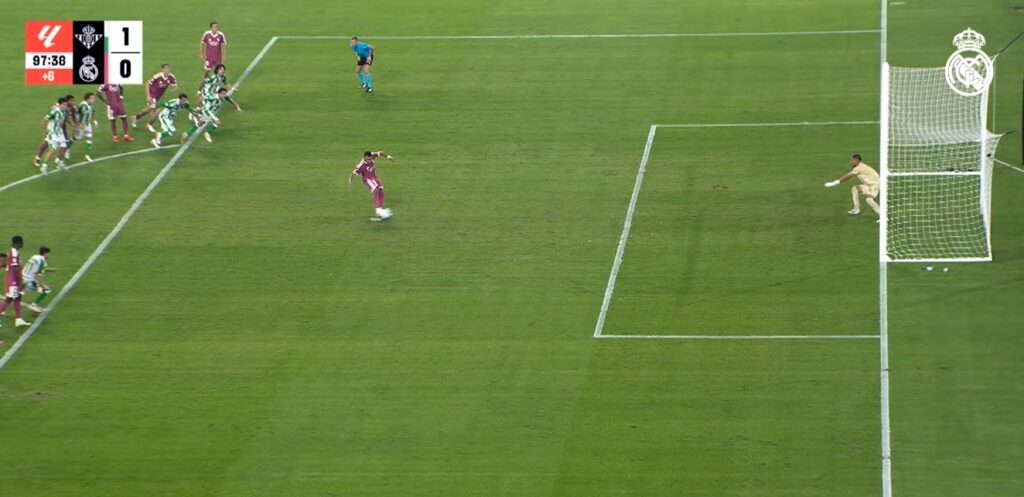
Real Madrid’s 1-0 defeat to Real Betis ended with a refereeing decision that deserves much closer scrutiny. Álvaro Vallés saved Kylian Mbappé’s stoppage-time penalty before Marc Bartra reached the rebound and cleared it away from the French forward.
The VAR check concluded without a retake because Bartra was airborne when Mbappé struck the ball and had not planted a foot inside the penalty area. That explanation may have matched the previous wording of the Laws of the Game, but it does not reflect the definition introduced for the 2026/27 season.
WHAT HAPPENED AFTER THE SAVE
Alejandro Hernández Hernández correctly awarded Madrid a late penalty after Natan brought down Vinícius Júnior. Mbappé took the kick, Vallés made the save and the ball returned to the field of play.
Bartra then reached the rebound ahead of Mbappé and knocked it behind for a corner. His subsequent involvement is therefore clear. He did not merely move towards the area without affecting play; he prevented Madrid from attempting a follow-up.
Spanish reports said the officials decided against a retake because Bartra had not touched the ground inside the penalty area when the kick was taken. His feet were still in the air as he crossed the line.
WHAT LAW 14 REQUIRES
A defender entering the penalty area early does not automatically result in a retake. Under Law 14, the encroachment must either clearly affect the penalty taker or have an impact after a rebound.
The law specifically penalises a defending player who encroaches and then plays the ball or challenges an opponent, preventing the attacking team from scoring, attempting to score or creating a goalscoring opportunity.
Bartra’s clearance satisfies the impact requirement. Had he encroached before Mbappé’s kick, his intervention on the rebound should have led to the penalty being taken again.
BEING AIRBORNE IS NO LONGER AN ESCAPE ROUTE
The decisive detail appears in the 2026/27 IFAB definition of a player’s position at a restart. When a player is airborne, their position must be determined by the projected position of their feet if they were touching the ground.
Consequently, the fact that Bartra had both feet above the pitch did not automatically place him outside the penalty area. The officials needed to consider where those feet would have landed. The available replay indicates that their projected position was on or beyond the penalty-area line, which forms part of the area.
The previous definition focused on the feet or other body parts actually touching the ground. The 2026/27 wording explicitly closes the airborne-player loophole. A media-reported interpretation based exclusively on whether Bartra had planted a foot inside the area therefore relies on an outdated test.
VERDICT: MADRID HAD A VALID CASE FOR A RETAKE
The available footage and the current Laws of the Game point towards a retake. Bartra appears to have been inside the penalty area under the projected-feet definition, and he then cleared Vallés’ save before Mbappé could attempt to score from the rebound.
Both elements required by Law 14 were present: early entry into a prohibited position and a direct impact on the subsequent play.
This does not prove that the decision cost Real Madrid a point. Mbappé could also have missed the second attempt. It does mean that Madrid appear to have been denied the retake prescribed by the current rules.
The final technical verdict would ideally use the precise frame showing Mbappé’s first contact with the ball and calibrated penalty-area lines. On the broadcast evidence available, however, the decision not to order another kick is extremely difficult to reconcile with IFAB’s 2026/27 wording.